.png)
by Zhu Yaozu
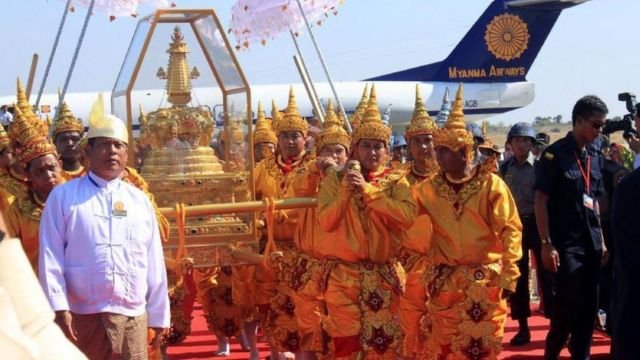 Buddha’s tooth Beijing relic arrives in Myanmar. Screenshot.
Earlier this month, in the magazine “Chinese Religion,” an interesting article was published on directives from the United Front Work Department(UFWD 統戰部). An intelligence agency established by the CCP authorities, it is used to gather information about and manage relations with democratic parties, intellectuals, dissenters, academics, religious and ethnic groups, and other individuals of influence, like business people, that are not directly associated with the Party inside China and abroad. Its main aim is to eliminate anti-communist forces or incite anyone outside the Party to support the CCP and its government. UFWD supervises nine internal bureaus, and among them, the second bureau is responsible for dealing with religious affairs; the seventh is in charge of Tibet-related matters, and the ninth deals with Xinjiang. UFWD also administers the five officially-sanctioned religious organizations. " href="https://bitterwinter.org/Vocabulary/united-front-work-department/" target="_blank" data-gt-translate-attributes=""html"}]" tabindex="0" role="link">United Front Work Department and the CCPIt stands for Chinese Communist Party, which from 1949 controls all social and political life in China. Members of CCP should in principle be self-proclaimed atheists. The ultimate goal of CCP is suppression of religion. However, how this goal is achieved has varied during time, and after Chairman Mao’s death the CCP has acknowledged that, notwithstanding its efforts, religions may survive in China for a long time." href="https://bitterwinter.org/Vocabulary/ccp/" target="_blank" data-gt-translate-attributes=""html"}]" tabindex="0" role="link">CCP to the government-controlled China Buddhist Association(中國佛教協會). Established in 1953, it is part of the red market and includes the government-approved Buddhist temples and associations, whose leaders are appointed by the CCP." href="https://bitterwinter.org/Vocabulary/china-buddhist-association/" target="_blank" data-gt-translate-attributes=""html"}]" tabindex="0" role="link">China Buddhist Association.
The text first underlines what is the purpose of China Buddhist Association(中國佛教協會). Established in 1953, it is part of the red market and includes the government-approved Buddhist temples and associations, whose leaders are appointed by the CCP." href="https://bitterwinter.org/Vocabulary/china-buddhist-association/" target="_blank" data-gt-translate-attributes=""html"}]" tabindex="0" role="link">China Buddhist Association. “General Secretary Xi JinpingThe secretary of the CCP since 2012 and the president of China since 2013. He has promoted a personal dictatorship and a cult of his personality reminiscent of Chairman Mao, and a crackdown on all religions stronger than in the previous decades, which found its legal expression in the new Regulation on Religious Affairs." href="https://bitterwinter.org/Vocabulary/xi-jinping/" target="_blank" data-gt-translate-attributes=""html"}]" tabindex="0" role="link">Xi Jinping stressed that winning people’s hearts is crucial and the United FrontAn alliance including the CCP, eight minor parties allowed to exist only to claim that in China there is more than one party, and the allegedly "independent” All China Federation of Industry and Commerce. For all practical purposes, the United Front is a tool of the CCP, but Chairman Mao believed that, by not using the name CCP, it was an extremely effective organization both in China and abroad. It was less important under Mao’s successors, but its role has been restored as central with the presidency of Xi Jinping." href="https://bitterwinter.org/Vocabulary/united-front/" target="_blank" data-gt-translate-attributes=""html"}]" tabindex="0" role="link">United Front is key to this.” The Association is there to make sure that, “The Buddhist community should follow Xi JinpingThe secretary of the CCP since 2012 and the president of China since 2013. He has promoted a personal dictatorship and a cult of his personality reminiscent of Chairman Mao, and a crackdown on all religions stronger than in the previous decades, which found its legal expression in the new Regulation on Religious Affairs." href="https://bitterwinter.org/Vocabulary/xi-jinping/" target="_blank" data-gt-translate-attributes=""html"}]" tabindex="0" role="link">Xi Jinping Thought on Socialism with Chinese Characteristics for the New Era, study and implement his views on the Party’s United FrontAn alliance including the CCP, eight minor parties allowed to exist only to claim that in China there is more than one party, and the allegedly "independent” All China Federation of Industry and Commerce. For all practical purposes, the United Front is a tool of the CCP, but Chairman Mao believed that, by not using the name CCP, it was an extremely effective organization both in China and abroad. It was less important under Mao’s successors, but its role has been restored as central with the presidency of Xi Jinping." href="https://bitterwinter.org/Vocabulary/united-front/" target="_blank" data-gt-translate-attributes=""html"}]" tabindex="0" role="link">United Front and religious work and unite religious believers. They should embrace Patriotism(愛國主義). The CCP uses slogans and rhetoric of civic patriotism to impose obedience on religions through "sinicization,” demanding that the love of country must always come before religion. The love of religion is tolerated just as a provisional and transient condition until all religions are finally eliminated. Through patriotism, "secular liturgies” are introduced in religious communities to ensure their observance of the "Core Socialist Values.”" href="https://bitterwinter.org/Vocabulary/patriotism/" target="_blank" data-gt-translate-attributes=""html"}]" tabindex="0" role="link">patriotism, align Buddhism with socialist values…”
Of special interest is the work entrusted to China Buddhist Association(中國佛教協會). Established in 1953, it is part of the red market and includes the government-approved Buddhist temples and associations, whose leaders are appointed by the CCP." href="https://bitterwinter.org/Vocabulary/china-buddhist-association/" target="_blank" data-gt-translate-attributes=""html"}]" tabindex="0" role="link">China Buddhist Association to advance Chinese interests abroad by “promoting friendship between Chinese and foreign Buddhist circles.” Follows a list of best practices. “China Buddhist Association(中國佛教協會). Established in 1953, it is part of the red market and includes the government-approved Buddhist temples and associations, whose leaders are appointed by the CCP." href="https://bitterwinter.org/Vocabulary/china-buddhist-association/" target="_blank" data-gt-translate-attributes=""html"}]" tabindex="0" role="link">China Buddhist Association has escorted the Buddha’s tooth relic from Lingguang Temple in Beijing to Myanmar, Sri Lanka, and Thailand for worship several times, enhancing mutual understanding and promoting good neighborliness and friendship. Friendly exchanges have been carried out with Buddhist circles of South Korea and Japan, initiating the establishment of the ‘China-Korea-Japan Buddhist Friendship Exchange Conference’ platform, and concluding the ‘golden bond’ of East Asian folk cultural exchanges. The Association deepened and expanded exchanges and cooperation between the Buddhist circles of China and the countries in the Lancang-Mekong River Basin, regularly holding the ‘Lancang-Mekong River Basin Buddhist Exchange Conference’ and helping build a community of shared future with China for Lancang-Mekong countries.”
In the future, the China Buddhist Association(中國佛教協會). Established in 1953, it is part of the red market and includes the government-approved Buddhist temples and associations, whose leaders are appointed by the CCP." href="https://bitterwinter.org/Vocabulary/china-buddhist-association/" target="_blank" data-gt-translate-attributes=""html"}]" tabindex="0" role="link">China Buddhist Association is told that it should “continuously strengthen friendly exchanges with the Buddhist circles in the Americas, Oceania and Europe, and co-host the ‘China-US-Canada Buddhist Forum’ and ‘China-Australia-New Zealand Buddhist Forum’ and other exchange activities, as foreign friendly exchanges are gradually globalized. It should continue and manage the ‘World Buddhist Forum,’ and strive to build a high-level international multilateral exchange platform for Buddhism with global influence and achieve remarkable results.”
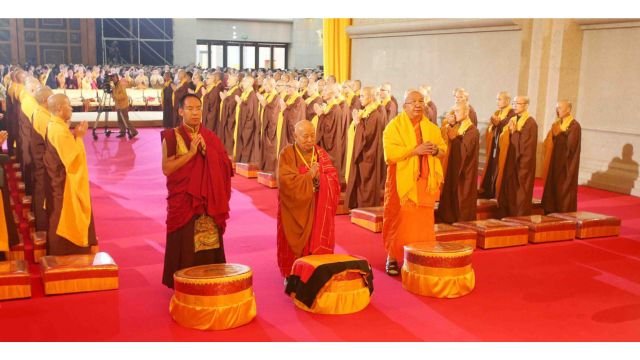 A World Fellowship of Buddhists international event. Credits.
The China Buddhist Association(中國佛教協會). Established in 1953, it is part of the red market and includes the government-approved Buddhist temples and associations, whose leaders are appointed by the CCP." href="https://bitterwinter.org/Vocabulary/china-buddhist-association/" target="_blank" data-gt-translate-attributes=""html"}]" tabindex="0" role="link">China Buddhist Association is also instructed to “participate in the activities of international Buddhist and religious peace organizations, “ including “the World Fellowship of Buddhists, the United Nations Vesak Day Committee, and groups such as ‘China Buddhist Harmony,’ ‘Asia Buddhist Harmony,’ and ‘World Buddhist Harmony,’ actively telling Chinese stories, spreading China’s voice, and promoting China’s image.” The ultimate aim is to foster “a solid social and public opinion foundation for friendship between China and foreign countries and create a favorable international atmosphere.”
Naïve Buddhists in democratic countries believe that by interacting with the China Buddhist Association(中國佛教協會). Established in 1953, it is part of the red market and includes the government-approved Buddhist temples and associations, whose leaders are appointed by the CCP." href="https://bitterwinter.org/Vocabulary/china-buddhist-association/" target="_blank" data-gt-translate-attributes=""html"}]" tabindex="0" role="link">China Buddhist Association they genuinely promote inter-Buddhist dialogue. In fact, the China Buddhist Association(中國佛教協會). Established in 1953, it is part of the red market and includes the government-approved Buddhist temples and associations, whose leaders are appointed by the CCP." href="https://bitterwinter.org/Vocabulary/china-buddhist-association/" target="_blank" data-gt-translate-attributes=""html"}]" tabindex="0" role="link">China Buddhist Association spreads international Chinese propaganda under the direct guidance of the United FrontAn alliance including the CCP, eight minor parties allowed to exist only to claim that in China there is more than one party, and the allegedly "independent” All China Federation of Industry and Commerce. For all practical purposes, the United Front is a tool of the CCP, but Chairman Mao believed that, by not using the name CCP, it was an extremely effective organization both in China and abroad. It was less important under Mao’s successors, but its role has been restored as central with the presidency of Xi Jinping." href="https://bitterwinter.org/Vocabulary/united-front/" target="_blank" data-gt-translate-attributes=""html"}]" tabindex="0" role="link">United Front. It is time for honest Buddhists abroad to cut ties with an organization denounced by international instances as promoting the persecution of Buddhists not aligned with the regime in China and Tibet.



 (1).jpg)
 (1).jpg)
 (1).jpg)
 (1).jpg)
 (1).jpg)