.png)
Nepal’s new leader yesterday vowed to follow protesters’ demands to “end corruption” as she began work as interim prime minister, after “Gen Z” youth demonstrations ousted her predecessor
Nepalese Interim Prime Minister Sushila Karki, the 73-year-old former chief justice, has been tasked with restoring order and addressing protesters’ demands for a corruption-free future ahead of elections in six months.
Protests began on Monday last week sparked by a ban on social media and quickly escalated, with parliament and key government buildings set ablaze, as they fed into long-standing economic woes in Nepal.
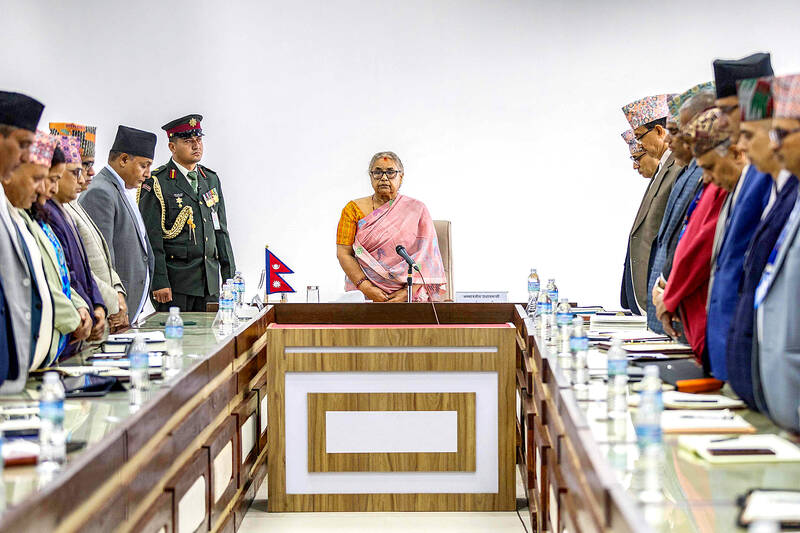
Photo: AFP
“We have to work according to the thinking of the Gen Z generation,” Karki said in her first public comments since taking office on Friday last week.
One-fifth of people in Nepal aged 15 to 24 are unemployed, according to the World Bank, with GDP per capita standing at just US$1,447.
“What this group is demanding is end of corruption, good governance and economic equality,” she added. “You and I have to be determined to fulfil that.”
Karki yesterday held a minute’s silence for those killed in the unrest, before meetings began in the key government complex of Singha Durbar — where several buildings were set on fire during mass protests on Tuesday last week.
At least 72 people were killed in two days of protests, and 191 injured, Nepalese Chief Secretary Eaknarayan Aryal said yesterday, increasing an earlier toll of 51.
It was the worst unrest since the end of a decade-long civil war and the abolition of the monarchy in 2008.
The appointment of Karki, known for her independence, came after intense negotiations by army chief General Ashok Raj Sigdel and Nepalese President Ram Chandra Paudel with representatives of “Gen Z,” the loose umbrella title of the youth protest movement.
Thousands of young activists used the Discord app to name Karki as their choice of leader.
“The situation that I have come in, I have not wished to come here. My name was brought from the streets,” Karki said.
Parliament has been dissolved and elections set for March 5 next year.
“We will not stay here more than six months in any situation, we will complete our responsibilities and pledge to hand over to the next parliament and ministers,” she added.
Workers put up a new signboard for the prime minister’s office in a building within the complex, but which was not torched.
Paudel, who swore Karki into office, said late on Saturday that “a peaceful solution has been found through a difficult process.”
Paudel called it a “very difficult, complicated, and grave situation” in the Himalayan nation of 30 million people.
“I sincerely appeal to everyone to make the most of this opportunity... in making the election on March 5 a success,” he said.
Soldiers have scaled back their presence on the streets, where they had been deployed in large numbers after the protests.
But more than 12,500 prisoners who escaped from jails during the chaos are on the run, and present a daunting security headache.
Regional leaders have congratulated Karki, including Nepal’s two giant neighbors, India and China.
Indian Prime Minister Narendra Modi said New Delhi supported “peace, progress and prosperity” in Hindu-majority Nepal, while Beijing’s foreign ministry said it wanted to “push China-Nepal relations steadily forward.”
Buddhism is the country’s second-largest religion, and the Dalai Lama, the exiled Tibetan spiritual leader, wished Karki “every success in fulfilling the hopes and aspirations of the people of Nepal in these challenging times.”



 (1).jpg)
 (1).jpg)
 (1).jpg)
 (1).jpg)
 (1).jpg)