.png)
Chinese President Xi Jinping (習近平) attended a grand ceremony in Lhasa yesterday during a rare visit to Tibet, where he urged “ethnic unity and religious harmony” in a region where China is accused of human rights abuses.
The vast high-altitude area on the country’s western edge, established as an autonomous region in 1965 — six years after the 14th Dalai Lama fled into exile — was once a hotbed for protest against Chinese Communist Party rule.
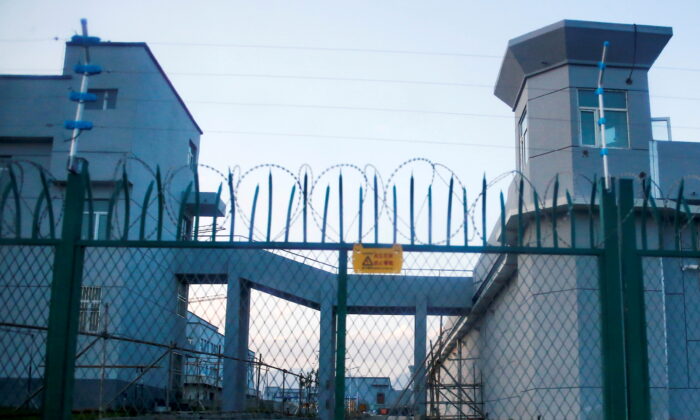
Rights groups accuse Beijing’s leaders of suppressing Tibetan culture and imposing massive surveillance, although authorities claim their policies have fostered stability and rapid economic development in one of China’s poorest regions.
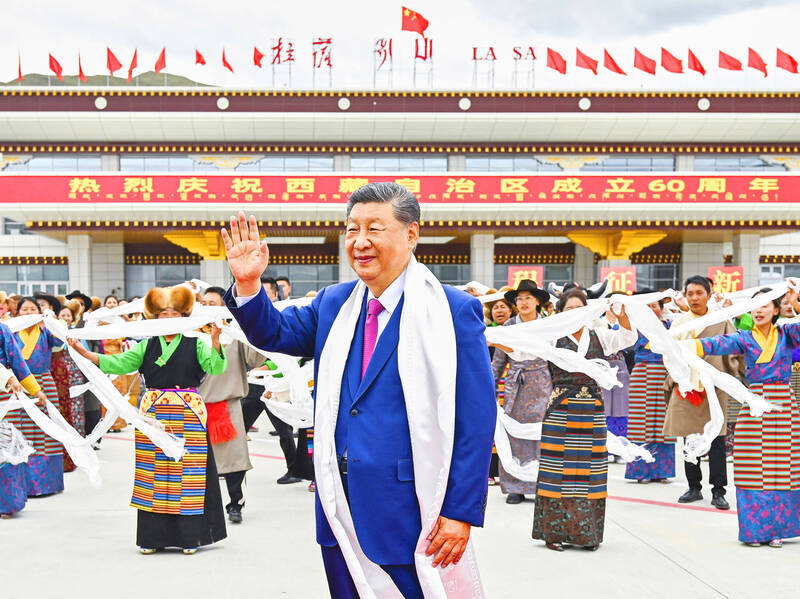
Photo: Xinhua via AP
“To govern, stabilize and develop Tibet, we must first safeguard political stability, social stability, ethnic unity and religious harmony,” state broadcaster CCTV reported Xi as saying on Wednesday.
Party officials yesterday lauded the region’s progress and urged ethnic unity during an event to mark the 60th anniversary of the founding of the autonomous region.
The ceremony was held in front of the Potala Palace, the ancient residence of Dalai Lamas.
Chinese People’s Political Consultative Conference Chairman Wang Huning (王滬寧) called for “deepening the anti-secession struggle, and ensuring the consolidation and security of the border areas.”
“Any attempt to split the motherland and undermine Tibet’s stability is doomed to failure,” he said.
A giant portrait of Xi flanked a crowd numbering 20,000, which included military personnel, schoolchildren and other members of Tibetan society, CCTV reported.
A parade followed, showcasing Tibetan dancers, floats emblazoned with official slogans and formations of troops.
Xi’s visit comes ahead of potential tensions over the succession of the 90-year-old Dalai Lama, who lives in India, where he established a Tibetan government-in-exile.
The Dalai Lama last month said the spiritual institution would continue after his death, with a successor decided “exclusively” by his office.
China’s rulers insist the next Dalai Lama must be approved by the government in Beijing, raising the prospect of two rival leaders of Tibetan Buddhism emerging.
Xi on Wednesday also called for “guiding Tibetan Buddhism to adapt to socialist society in accordance with the systematic Sinicization of religion.”
He made no mention of the Dalai Lama.



 (1).jpg)
 (1).jpg)
 (1).jpg)
 (1).jpg)
 (1).jpg)